

Images shot on Fujicolor C200 in the Yashica Electro 35 GSN
Before I lived in Shanghai, a place I’ve shot more photographs of and written about more than any other on this website, I lived in a small town in southern China called Yangshuo.
As you can see from this picture of Yangshuo nestled between its trademark limestone karsts, it’s a beautiful place, and one that gave me some of the best times of my life so far.
When I was there, I wasn’t into photography anywhere near as much as I am now. The thought of shooting film certainly never crossed my mind back then. So it was nice to return some years later and get through the roll of Fuji C200 you see the results of here.
The place has changed a lot since the days I called it home. Depending on your perspective, this may or may not have been for the better. We can get into the whys and wherefores of that later.
For now, I want to show you some long overdue Yangshuo film photography. First from a couple of trips outside the town and then some shots from Yangshuo itself.

Contents
A trip out to the Yulong River’s Dragon Bridge
There are two rivers you’ll likely encounter if you ever go to Yangshuo. The first, called the Li River, runs alongside the town. Large passenger ships come down this one bringing people on sightseeing cruises from Guilin.
The second river, called the Yulong, is a very pleasant bicycle or scooter ride through the countryside away from Yangshuo and free of these vessels.
However, once you get to the Yulong’s scenic Dragon Bridge, which is one of the more popular spots for any kind of Yangshuo photography, you’ll see that it isn’t free of hundreds of bamboo rafts offering rides along the water.
I’ve taken a few of these rides myself back in the day and can tell you it was a nice way to spend an hour or two. I can also tell you the first time I ever went to this bridge, as two old photo photographs I’ve dug out will show you below, there were 10x fewer tourist rafts there.
In fact, the bridge was a spot where people – other people, not me – would jump off into the river. Looking at all that’s going on beneath it now, that would be impossible today.
I’m not bemoaning this change. I’m just pointing it out. If people can make money from the endeavour, the tourists enjoy it, and the environment is looked after – notice the rafts are engineless – more power to them all, I guess.


A trip out to neighbouring Xing Ping
Another hugely popular trip out of Yangshuo is to the smaller, quieter town of Xing Ping. It’s easily reachable with regular buses making the hour-ish journey throughout the day. While still less developed than Yangshuo, and I imagine it always will be, it has changed since the first few times I went.
I remember a high street of mainly closed-up old buildings in the town. Whether they were unused or not, I don’t know. Perhaps people lived there. But they certainly weren’t doing any sort of business from them. There was also a poorly-maintained road that you had to share with vehicles as you strolled along the river.
This time, years later, I found the high streets to be far more busy with cafes and restaurants, with some houses still there in between too. There’s also now a wooden walkway that keeps you separate from the cars and 20-person golf carts transporting those who can’t or don’t want to enjoy the scenery on foot.
This walkway takes you to the spot of probably the single most common activity in Xing Ping, by the way. The holding up of a 20RMB note in front of the view that features on it and taking a photo.
Again, I’m not knocking any of these developments. I think they make Xing Ping objectively better for visitors and locals alike.
And once again, I’ve delved into my hard drive to find two old photographs that show what it was like before, and also the 20RMB money shot, so to speak.


And now back to Yangshuo itself
If the Dragon Bridge bamboo raft business and Xing Ping town have both developed in the years I left, it should come as no surprise that Yangshuo itself has too.
We are talking around a decade since I first went there to this time when I shot this inexpensive Fujicolor film though, and most places on Earth will have changed in that time. That said, not many will have changed as much as Yangshuo if we look over the last twenty or so years instead
Back before I’d ever heard of it, Yangshuo was a hangout for western backpackers. It remained this way for a long time as most of the local tourists, travelling on package tours, wouldn’t make it past Guilin.
Maybe I just caught the very tail end of that version of Yangshuo. Of course, people who were there years before me will tell me it had already changed, just as I feel it has changed in the years since.
The topography is still the same, but the atmosphere was something else. Just unlike anywhere I’ve been in China. Almost as if a piece of South East Asia had been transplanted in.
The high number of private English schools in town helped sustain a healthy long and medium-term foreign population in the early 2010s, and there were still plenty of foreign travellers passing through too. Both of these meant plenty of cheap and chilled cafes catering to us all.
Kelly’s Cafe, Lucy’s Cafe, Backstreet Cafe, Minority Cafe. Everyone had their favourite. Minority was mine, by a mile.
When I went back this time though, the cobbled street that was once so busy in the daytime with these places was now dead until the evening, having been turned into yet another strip of bars and clubs.
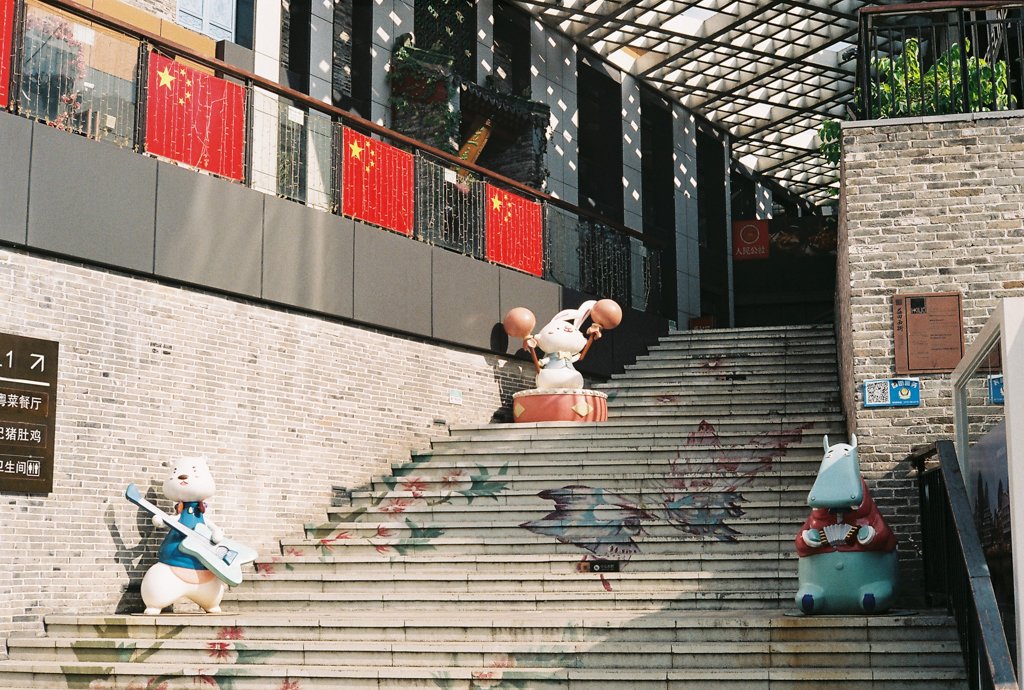
The whole town felt different. Less carefree, and with a lot less character too. They built a shopping mall. They got a Starbucks. Yangshuo, which used to be in its own category of one, began to resemble most other places in China.
In a nutshell, Yangshuo changed from a foreign traveller destination to one more for the local tourists. I guess this is down to economics. Most things are.
The former began to have less money to travel while the latter began to have more. And you can’t blame the local government and businesses for wanting to sell to rich Chinese people rather than broke backpackers.
The majority of the English schools closed too, which decimated the number of those long and medium-term ex-pats in town. Another reason, along with the ever-increasing rents, that the cheap cafes and bars we all used to frequent had to close.


Why Yangshuo is still beautiful to me
I need to stress again that this is not me complaining about the development of Yangshuo. It’s not an old man yells at cloud moment. I hope.
For one thing, who am I to tell people how to run a town in their own country? If they want to change things, for better or worse, it’s completely up to them.
For another, the place is still beautiful to me, and I think it always will be. I have my memories, and I found some of them were awakened as I wandered away from the touristy town centre shooting these photographs.
They might look mundane to other people, but going back to the streets you used to live on will do something to anybody, I think.
There’s also the small matter of those limestone karsts everywhere you look too. Whatever happens to Yangshuo, good bad or ugly, they’ll always be there.


And finally, the Li River too. As mentioned, it’s generally less peaceful than the Yulong as it runs right next to Yangshuo. The good thing about it though is that it runs right next to Yangshuo. If you need a place to sit and think, it’s right there.
I’m not sure when I’ll be back in town. When I went this time, I knew it might be the last. So on my final evening, there was only one place I wanted to be for the sunset.
After finishing up the roll of film, which you can learn more about in my full Fujicolor C200 review, I got myself a couple of cans of local Liquan beer, sat looking across the Li River, and did some thinking.
There was nothing about the moment that wasn’t beautiful. The familiar scenery. The memories of the old days in Yangshuo. Even the beer, which was almost as watery as the river in front of me that it was named after.
Yangshuo has changed since I lived there. I hear people say it’s been ruined. I think that’s a matter of opinion and perspective. There’s no doubt it’s different to how it was, but I think I’ve made my feelings clear.
There’s no point complaining about change you can’t stop happening. Not when you can remember the good times and hope to have more instead.
Yes, it is now a massive tourist trap. But, perhaps for the memories even more than the geography, Yangshuo is still beautiful to me.
If you enjoyed that post, why not take a look at these others to stay inspired or learn more about the Fujicolor C200 film I used here:
- My complete Fujicolor C200 review
- Another photo essay from a small Chinese town
- Shooting Fujicolor C200 on the beach
And if you think others will enjoy this account of Yangshuo too, help them find it by sharing or pinning. 😀

Great post. I travelled through Yangshuo and got stuck at Monkey Jane‘s Backpacking Hostel for a week in 2011. I had a fantastic time, doing all the things backpackers do, still cherishing these memories. Hence, I was extremely excited to bring my parents here on a short trip. While I really enjoyed the river cruise in one of the big boats (which is a thing that was out of my budget last time I visited) I was surprised at what has happened to Yangshuo. I had promised my parents a more laidback destination than Guilin but it turned out to be way more busy. As you mention all the cafes and bars I went to are gone, now there are night clubs and a whole new area with shopping and food joints that didn’t exist before…
It reminds me a lot of Lijiang in Yunnan now. A bucket list travel destination for all Chinese with a quaint local flavour. As you mention it all makes sense. During covid the Chinese started exploring their own country more, as well as the outdoors. Now you can even see people camping along the Li river. Yangshuo therefore is a great place to see first hand how China has developed in the past 15 years.
It’s still beautiful due to the scenery but definitely catering to a new group of customers. I absolutely dig the girls dressing up like locals to take pictures everywhere. They make for a great snap. I am glad I came back but not sure I will bring anymore guests here anymore.
Hey Lisa. Thanks for the kind words re. this post. It’s appreciated. 🙂
You would have been there the same time as me on your first visit as I was living and working there for most of 2010 and 2011. Was a frequent visitor to The Amazing Rooftop Bar Of The Marvellous Monkey Jane also! A legendary place back in the day and it being long gone is I guess another symptom of what you say about Yangshuo.
I went back to YS a few times after I left to live in Shanghai – specifically in 2012, 2015, 2019, and most recently in 2023*. It was shifting further from what it was and over to what it is now with each visit. I’m sure covid had an effect as you say, but it was happening before that anyway, in my view.
*btw that last one was after I’d moved back to the UK in 2020, but I was back in China to get married to the girl I’d met in Yangshuo in 2010 and been with ever since so we had a quick few days back where it all started for us too. Nice to take things full circle sometimes 🙂
I’ll give my overall view here. I might be wrong on some things, but it’s just the way I see it.
I feel like the biggest reason for the change is that back in the day (up until around the 2010-ish timeframe we’re talking about here) it was Western backpackers that had the money, and most of the businesses in YS were set up to serve them. I used to see the place as like somewhere from the Southeast Asia backpacker trail transplanted into China. Like a Pai or a Vang Vien or something, when there were precious few of those in China and a lot of backpackers stayed away from the country as a whole anyway. And that was a big part of what made it special.
After 2010, something shifted in the global economy – i.e. financial crisis in the west and China booming – where less Western backpacker money was coming in but the domestic Chinese had more money to travel with, and they were now coming to YS. I can’t blame the local businesses one bit for changing what they did to serve this new type of customer, which was both richer and bigger in number.
Another change from when I worked there is that pretty much all of the schools are gone. We were all working at places that adult students came and studied privately at, rather than teaching kids at ‘real’ schools. When I rocked up looking for work, there were maybe eight or ten places I could have got a job at. The last time I went back, there were maybe one or two at most?
What this means is no longer a population of long term foreigners. We’d be happy to sit in (or outside) the cafes all day and evening whenever we didn’t have classes to give, along with a lot of the Western backpackers doing similar. Town used to be buzzing in the daytime because the Westerners liked being in town in the daytime. Nowadays, it’s dead by day with all the cafes gone and nightclubs not open until… nighttime.
Another part of the reason town is a lot more quiet in the day now is that most of the daytime activities now are out of town. People don’t want to be in YS during the day. They want to go and do stuff out of town and come back for a night out there. Hence the cafes becoming nightclubs.
There is far more to do just outside the town now. I remember always going out to the Yulong and it being a lovely quiet, rural bike ride. Now there’s a lot more developments and stuff to do at the sides of the road a lot of the way, and much busier when you get there too. Dragon Bridge et al.
You mention the big cruise boats too. A lot of them coming from Guilin? I remember we used to swim in the river with our students most days after school in the summer of 2010 at that dock where they now moor up. Impossible to do that now!
I like what you say about YS being, as well as everything else, a good case study in how this element at least of China has changed in the last 15 years. It’s absolutely bloody tangible to those of us who saw it then and now and can compare.
I feel also though it’s perhaps a symptom of many parts of/in the world becoming more homogenised too. A lot of things that were different and special revert to the mean and become like everywhere or anything else if that is what brings in more money and that’s obviously a great shame.
But at least we’ll always have the memories of 2010/2011 Yangshuo. It was a magical, magical place for sure. 🙂