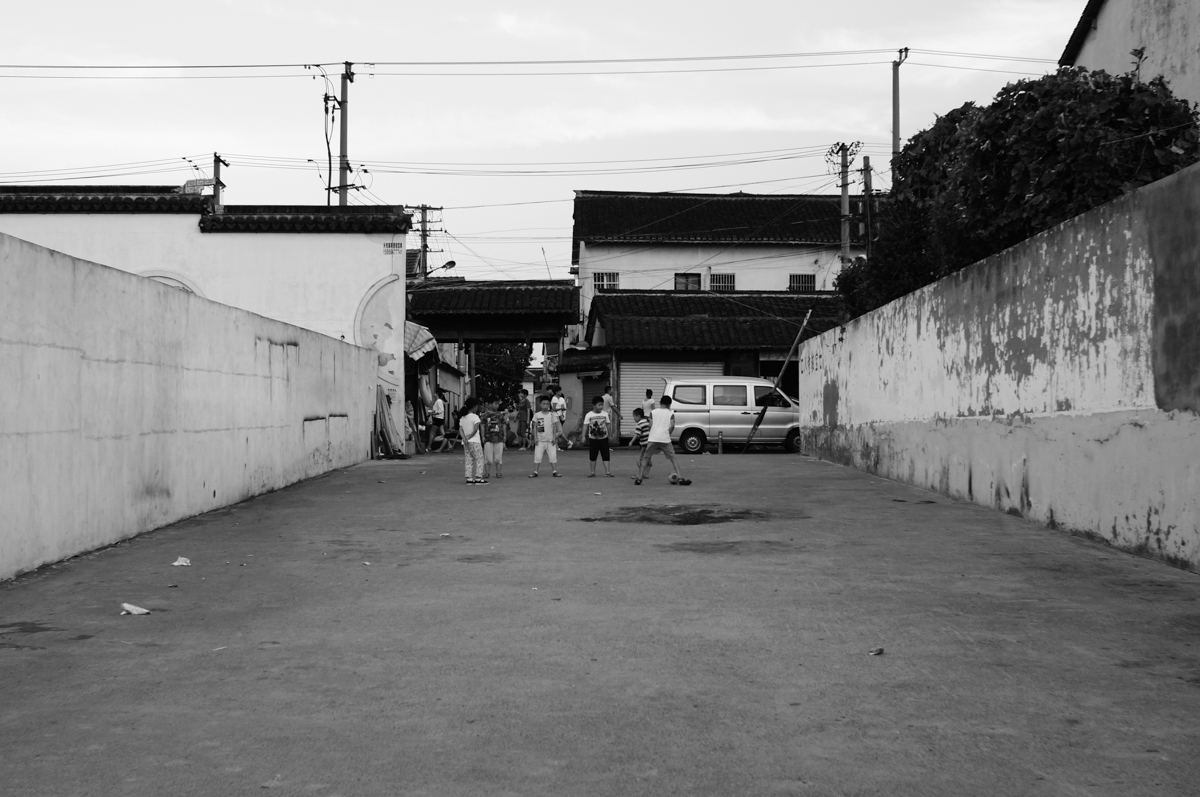
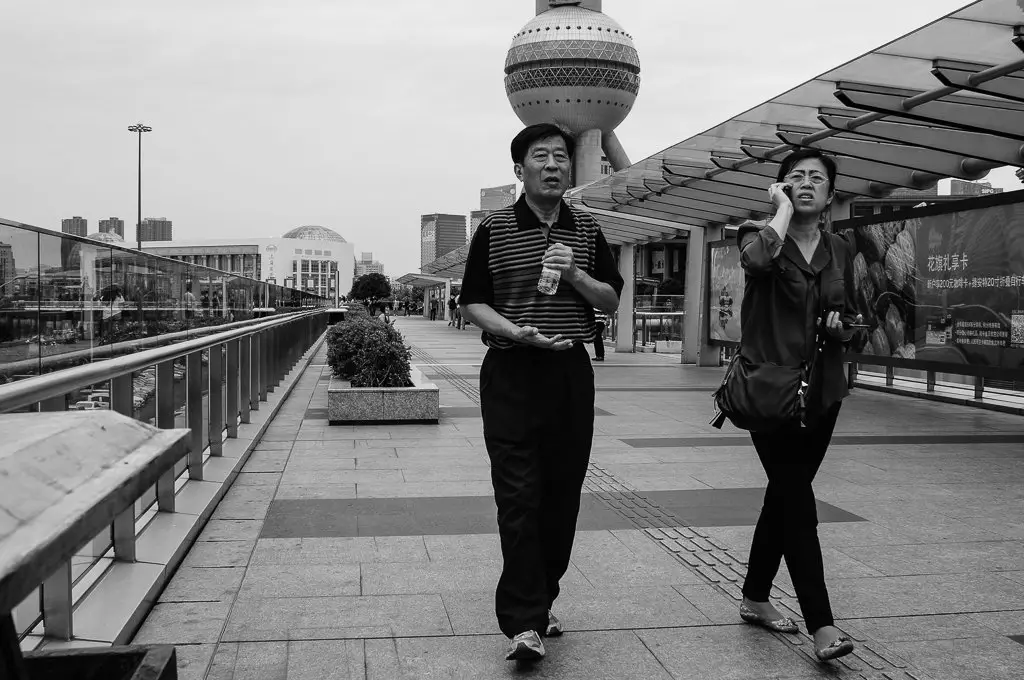
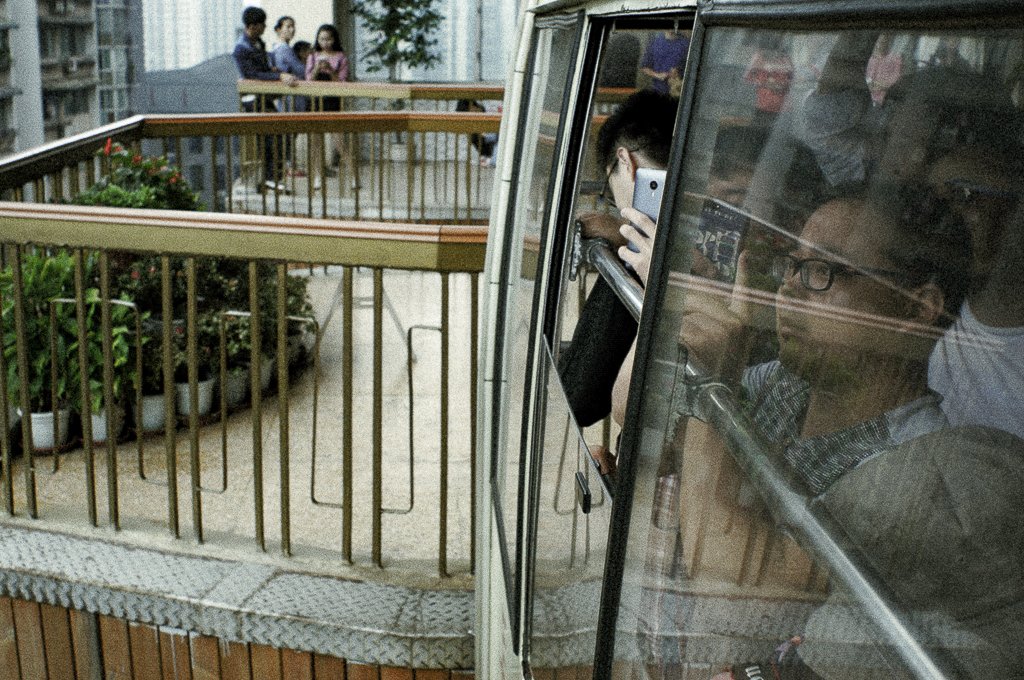
Shanghai Disneyland Street Photography [Super-Takumar 28mm f3.5]

A day out at Shanghai Disneyland, with all the expected crowds and activity, seemed like a good opportunity to shoot some street photography. So I packed my camera and went to my first, and at the time of writing only, Disney park.

Having read some negative press about the whole park experience beforehand, I was unsure how exactly the day would go. What I felt more sure about was my chances of coming back with some images worth sharing here.

As you’re reading this, that’s what happened. So come on in. Check them out. And let me know what you think of them, and how your own theme park street photography went if you’ve ever tried any yourself!

Create or Hate by Dan Norris – Book Review

Create or Hate, the 4th book by Australian entrepreneur Dan Norris, has been written with one goal in mind – to get you to create something today.

The titular Hate (with a capital H) isn’t the kind that’s directed at other people. It’s an internal self-hate that creeps up if we let it and stops us from creating the things we say we want to create. The key is recognising and suppressing it.

Motivational media has perhaps never been as popular as it is now, so what did I take from this book? Come find out in this review.

Make Your Street Photography Better than Average [Super-Takumar 28mm f3.5]

How’s your street photography? Good? Great? Average? Not sure which? I’ll stick my neck out and say it’s probably the last one. Average. Most people’s is. That represents an opportunity, though.

You want to have your street photography noticed? Then you don’t necessarily need to be great. Not yet. Just get yourself above average.

You want to know how? I’ll give you four ways. None of them are groundbreaking, or even difficult to put into practice. You just need to come and make the effort.

Street Photography Clichés: Get Over Them [Super-Takumar 28mm f3.5]

Street photography clichés, such as people walking past pictures and signs or people using their mobile phones, make up a huge percentage of the street photography posted online.

It’s an important step in the development of a street photographer, but there often comes a time when you’ll want to shoot something more original. Perhaps more importantly, there also comes a time when your fans will want to see something more original.

The question is, when the time does come, how can we get over clichéd street photography? Come find out in this post.

Effort Justification and Your Street Photography [Super-Takumar 28mm f3.5]

Effort justification is making you overestimate the quality of your photography. Because you know how much work went into creating it, you hold it in higher regard than anyone else does. And then you wonder why nobody thinks it’s as good as you think it is.

It’s not confined to photographers, of course. Anyone who creates anything will have a skewed idea of its worth. The important thing is to understand this and try to remove it as much as possible. Doing so will help you know what to publish and what to shelve, and to understand why your work might not be getting the acclaim you think it should.

Lessening the effect of effort justification isn’t as difficult as creating your thing was in the first place, but it might take more time. Come learn how here.

The Swimmer’s Body Illusion and Your Photography Blog [Super-Takumar 28mm f3.5]

The swimmer’s body illusion is what makes us think enough lengths of breaststroke can give us the physique of an Olympic athlete. It’s what makes us think some cosmetics can have us looking like a supermodel, and that Oxford is producing genii rather than taking them in.

It’s also something you can use to your benefit with your photography, blog, or anything else you want to do well in. Once you understand the concept, you can use it as a guide to building on your strengths and letting someone else do what you’re average at.

Come learn more about how this cognitive dissonance affects us all, every day, and how recognising it can help you turn it into your advantage.

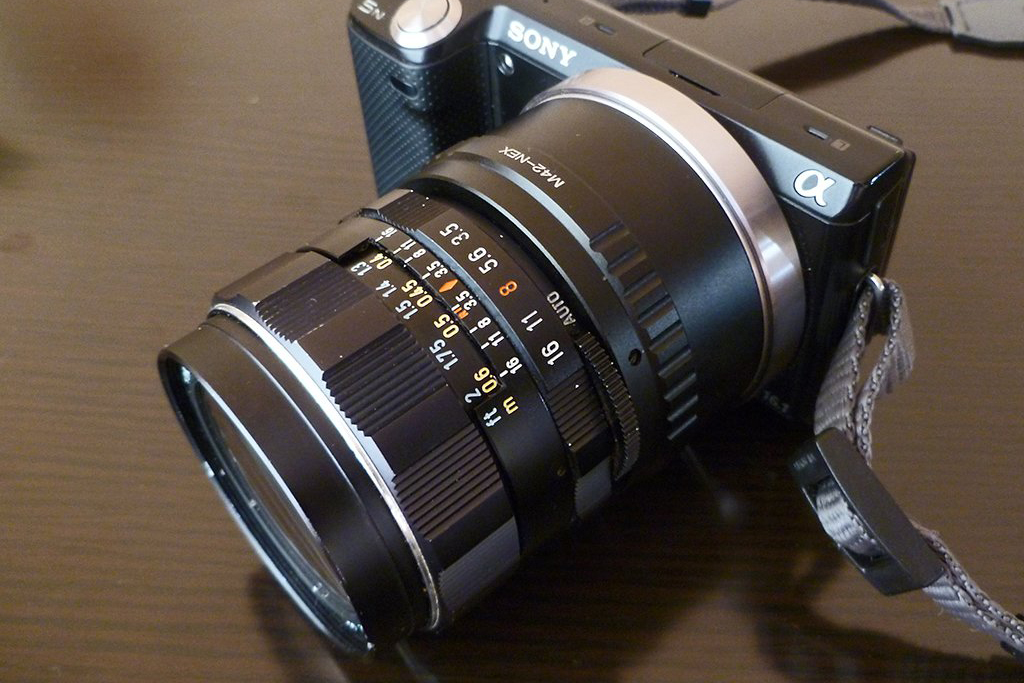
Super-Takumar 28mm f3.5 Lens Review

The Super-Takumar 28mm f3.5 is the third vintage lens I bought, and it helped me take a big step forward as a street photographer. Shooting wide open with f1.8 lenses is fun, but foregoing the shallow depth of field and looking for other ways to make interesting pictures adds a whole new level of fun.

In the beginning though, I wasn’t sure how much I would enjoy using this lens. After being so used to other focal lengths, I was struggling to take any pictures I really liked. With practice, that changed. I now love this little block of metal and glass.

It’s a vintage lens I think you’ll love too if you pick one up. Come see why in this comprehensive review of the Super-Takumar 28mm f3.5 – with sample shots included.

Beware of Social Proof with Your Photography [Super-Takumar 28mm f3.5]

There’s probably not a photographer alive who doesn’t want people to tell them what they do is good. However, chasing the approval of an audience over an artistic vision can be damaging for the quality of the work.

Social proof is a powerful thing, but is the social proof demonstrated by the number of ‘likes’ on social media something we should assign any value to?

Of course, it depends on your goals. But if you’re looking for a photographic legacy you can be proud of rather than Insta-fame, chasing the social proof as seen on social media could be holding you back. Come read more to find out why.

Nanchan Temple, Wuxi, China [Super-Takumar 28mm f3.5]

Visiting a temple is always high on my list when I go to a new town or city. Not to pray, but to just go take a look. Just to see if it’s a nice temple or not, really.

One bonus of doing this is I always feel better when I leave than I did before I went. Something about the buildings, statues, and iconography I suppose.

Nanchan temple in Wuxi was pretty nice, and climbing the pagoda meant I could get some urban landscape shots of the surrounding city. So that’s another bonus of visiting temples. Being able to share the photography with you. Don’t leave me hanging. Come take a look.

Be a Factory, Not a Warehouse

You often pick up the best advice from the most unexpected places. I was listening to a podcast today when that exact thing happened.

Steve-O was never my favourite person on ‘Jackass’ but I gave his interview on the Joe Rogan Experience a listen. And I am so glad that I did.

A wholly surprising and inspiring life story for sure, but it was one statement in particular that moved me to write this post. The title is paraphrased, but I think anyone who sees themselves as a creator needs to hear the message. And that includes you.

Playing is Winning (a.k.a. the process is the result)

I like the maxim ‘the process is the result’. Playing the game, rather than worrying about who wins and loses, is where the value is.

Going out with your camera and enjoying your day, rather than coming back with a slew of keepers, is what brings the most benefit to your mind and body.

Writing this blog post probably did me more good than posting it will. Reading it will do you more good than if you don’t. So come on in and give yourself the gift of both the process and the result.

Monochrome Hong Kong Street Photography [Super-Takumar 55mm f1.8]

A small set of images left over from the previous two posts. I didn’t have any reason to publish them before, apart from ‘to just get them off my hard drive and onto my blog’.

However, I got some words of wisdom that made me realise that’s actually a great reason to publish them. Come take a look. Especially if you’re struggling to get your own work out there for whatever reason.

I can’t promise words of wisdom of my own, but I will point you in the direction of the ones that helped me out.

Costumes and Countryside in Xijiang, China [Super-Takumar 28mm f3.5]

Sitting in China’s southern Guizhou province, Xijiang minority village is a popular spot to take in some local Miao culture, and to enjoy the relative peace and fresh air.

With traditional wooden homes built on the hillsides, picture postcard bridges, a river flowing gently through the valley, and plenty of residents and tourists happy to pose, it makes for a highly photogenic trip.

Want to see exactly how this looks when shot with a vintage camera lens? Well then come on in and take a look.

Behind Bars in Shanghai [F.Zuiko 38mm f1.8]

Another article with photographs shot around a single theme. Despite the title, none are taken in prison. Although wiseacre metaphors with modern life can be drawn if you wish.

Walk around any city with a photographic theme in mind and you’ll always find things to shoot. This is what I came up with after walking around Shanghai with the idea of Behind Bars in my head.

Come take a look. Digest it. And get inspired for your next photography set centred around a single theme.

Transcending Travel – Photography eBook Review

If you’re looking for a way to improve your photography, the single best thing you can spend your money on is education. Classes and workshops would be my number one choice. However, they aren’t always affordable, convenient or even available.

A more cost-effective way to widen your skills is with good quality eBooks. I picked up Transcending Travel from Digital Photography School, took it on a trip with me, and tried some of what it teaches. I returned from that trip with a wider skill set, photographs the likes of which I’ve never taken before, and the inspiration to keep improving further.

Come and see how, and how you can do the same, in this review of the Transcending Travel eBook.

Visiting Chongqing’s Luohan Temple [F.Zuiko 38mm f1.8]

Chongqing’s Luohan Temple is probably best known for the 500 clay arhat figurines from which the complex takes its name. It’s also a calm oasis in the middle of one of China’s most populous cities.

While not the most photogenic temple I’ve ever been to, it’s certainly worth a visit, should you ever find yourself in the neighbourhood. Which I would recommend you try to make happen, as Chongqing was a pretty cool place to visit in its own right.

Chongqing’s Bang Bang Men [Super-Takumar 55mm f1.8]

Much like travel itself, travel photography becomes more interesting when you consider the people as much as, if indeed not more than, the scenery. The huge Chinese city of Chongqing certainly has some great vistas, should you be lucky enough to get a day clear from the smog. However, what of the local people?

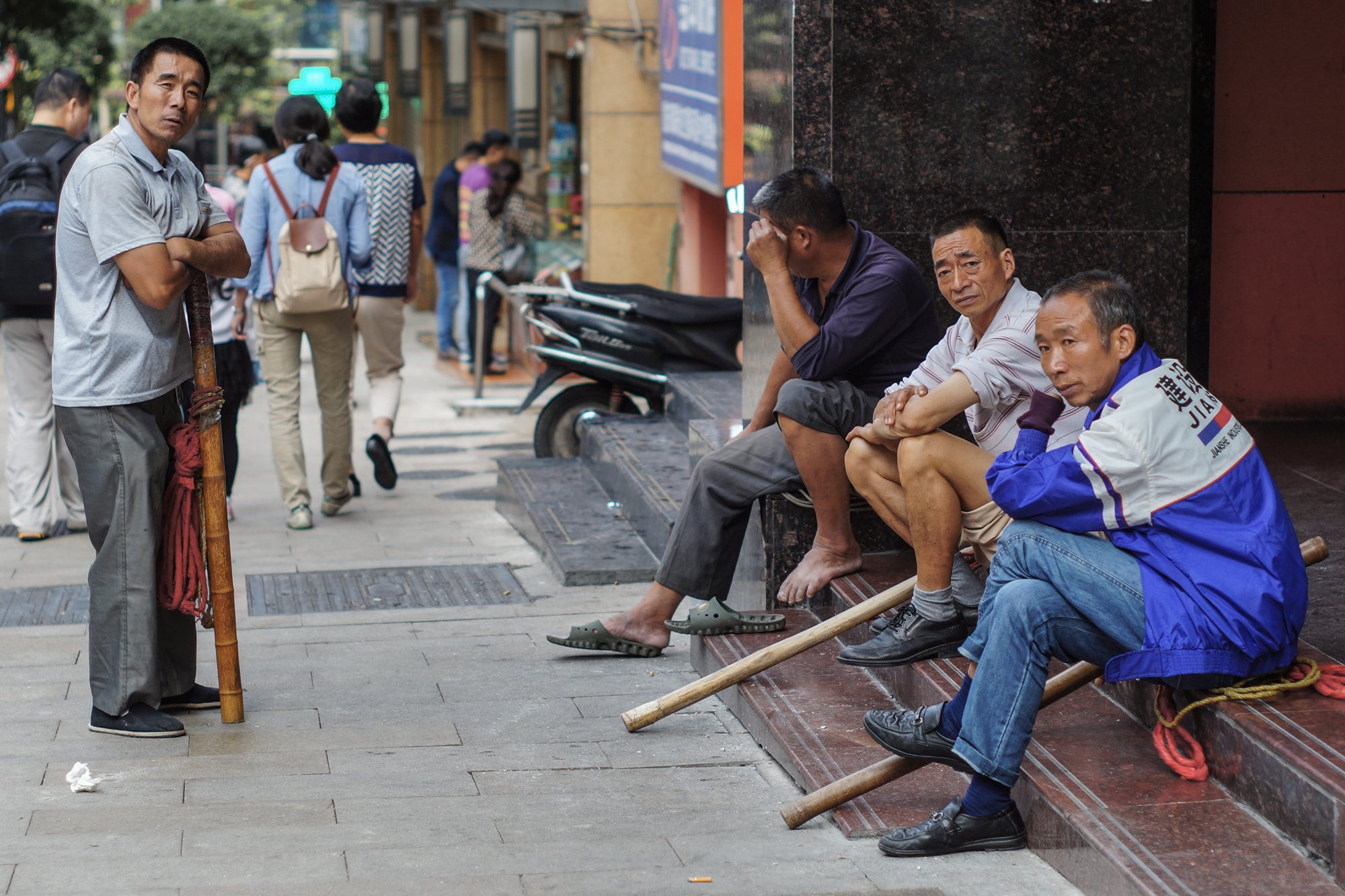
A unique employment opportunity exists in Chongqing. Due to the steep hills upon which it is built, the city is home to thousands and thousands of street porters known as bang bang men and women. Armed with a bamboo pole and some rope, they will for a fee carry anything that needs carrying.

As iconic as the city’s signature spicy food, this is my photoblog of Chongqing’s bang bang men.

Checking out Chongqing’s Cable Car [Super-Takumar 28mm f3.5]

Although Chongqing is technically China’s biggest city by area, it’s often not on the tourist map for those visiting from outside the country. It was never on my list either until circumstances made it the best option for a short trip. For those tourists who do make it to Chongqing though, its cable car is one of the more famous things to see and do.

But is it worth it? Both the city and the cable car? Should they go onto your own list? I went to Chongqing expecting to enjoy it, but not knowing why. I came away having enjoyed it and for a reason I could never have anticipated.

With a few lovely pictures to look at too, this is me checking out Chongqing and its cable car.

A Lap of Ko Samui on a Scooter [Super-Takumar 55mm f1.8]

Despite having been to Ko Samui numerous times, and spending longer there than I have on any other Thai island, I’d never really been and explored away from the tourist centres in the north and east before. I’m not sure many visitors do. During my most recent trip there, I decided to remedy this by renting a scooter and doing a lap of Ko Samui.

Although the island is very well developed, I’d heard its southwest area was quieter. Keen to see it for myself, and looking forward to documenting some of the tourist activity in the towns of Chaweng and Lamai too, I devised a rudimentary plan and set off on a day of riding and shooting.

With plenty of sights, beaches and people to photograph with the Super-Takumar 55mm f1.8, this is what I came back with.

Lopburi, Thailand – a Day in Monkey Town [Super-Takumar 55mm f1.8]

Sitting around three hours north of Bangkok and easily reachable by local bus or a cheap train, Lopburi is unlike any other place in Thailand. While having a whole area of a town overrun by hundreds of small monkeys may seem like the stuff of nightmares for some, it makes Lopburi a dream stop-off for travel photographers.

It’s also small enough to do in a day if you don’t want to stay the night. I arrived on an overnight train from Chiang Mai just before 4am and left for Bangkok around 3pm. In between, I went shooting monkeys. With my camera. In monochrome.

From a pre-sunrise market to an afternoon festival, and with enough shots of the local primates to make the title work, this is Lopburi, Thailand – a Day in Monkey Town.

On the Road to Pai [Super-Takumar 55mm f1.8]

road sign between chiang mai and pai

Chiang Mai to Pai on a scooter. I’d done it before, but I wanted to do it again, and I wanted to do it differently. Photographically differently. The previous times I’d been to Pai I’d shot in colour, because that’s what people do when shooting travel photography, isn’t it?

To make this trip different, I decided to go less ‘travel’ and more ‘road trip’. A classic, monochrome, echoes-of-the-50s road trip. That didn’t mean merely shooting the same pictures but in black and white. It meant a whole different feel to both the individual images and the set as a whole.

A classic monochrome road trip then, in Northern Thailand. Come and see how it turned out.

Buying a Train Ticket in Bangkok [F.Zuiko 38mm f1.8]

monochrome bangkok train station

Public transport links to Khao San Road in Bangkok aren’t the best. Although the city has both its Skytrain and underground connecting the new airport and train station with the city centre, it doesn’t quite extend to the infamous backpacker area.

This means if you’re at Khao San Road and you want to buy train tickets, you have maybe three options; go to a travel agent and pay their commission, pay for a taxi or tuk-tuk to the station and back, or take the hour long walk in the Bangkok sun.

Me? I slung my camera over my shoulder and chose the third option. These are the pictures I came back with, along with an important piece of advice for buying your own train tickets in Bangkok.

The Train from Suzhou to Shanghai [F.Zuiko 38mm f1.8]

bullet train at suzhou station

As the name suggests, this post tracks a short trip from Suzhou to Shanghai on an evening train. Although I hadn’t been planning on documenting the journey, I decided to shoot a few photographs and see how it turned out after not shooting anything over the couple of days I spent in Suzhou.

Starting in a Suzhou metro station, I shot until the train pulled into Shanghai later in the evening. I think the six shots that make up The Train from Suzhou to Shanghai describe the journey better than I can here. So please, come take a look.

Two Days in Xitang Water Town [Super-Takumar 55mm f1.8]

chinese lanterns in xitang

One of many scenic water towns near Shanghai, Xitang makes for a great little photography trip. The only problem is, when a place is so photogenic and visited by millions of tourists per year, how do you go about making your pictures even a little bit different to everyone else’s?

To help me with this, I went against the norm. Taking only a 55mm lens would mean I wouldn’t be able to take the wide angle water-and-traditional-houses shots that are so common. As ever with my photography, I’d have to seek out the smaller details and get closer to my subjects.

Thankfully, Xitang provided enough of those to allow me to come away with a set that I am very happy to share with you.

Shanghai Old and New [F.Zuiko 38mm f1.8]

high rise apartments and old houses shanghai china

The photographs here in Shanghai Old and New were, unsurprisingly, all shot in Shanghai, although not all at the same time. Not even all in the same year, in fact. The theme though *is* Old and New, so I think I can get away with using pictures that fit that description too.

It’s really a quick snapshot of a tiny part of Shanghai life, starting with a familiar urban view and exploring things perhaps only known by those who have been to China, with a couple of visual examples of the country and its biggest city’s march into a new age of financial muscle, as evidenced by demolition, construction, and shiny new buildings.

Shanghai Street Scenes [F.Zuiko 38mm f1.8]

While most of my posts on here are about trips I take or days spent in places taking photographs, I thought posts that concentrate on the images themselves would make an interesting distraction.

Shanghai Street Scenes features five shots I took during one day in Shanghai. Being a December morning, the winter sun provided a very nice light for the shots, and the people who were keen to place themselves in it for the warmth made worthy subjects.

If you want to hear a little photo critique instead of the usual travel-type posts, come see the images I got from that Shanghai morning and get the story of why I shot them.

Circles in Chiang Mai [F.Zuiko 38mm f1.8]

bicycle at chiang mai sunday walking street

It’s sometimes easy to lose motivation or simply not find any inspiration for your photography, especially when living or staying in the same place for a long time.

If this does happen, choosing a theme before going out shooting is a great way to give a reason to shoot things you maybe normally wouldn’t, to give meaning to a set of photographs, and to help train your eye to see the smaller details wherever you may be.

The theme for these pictures in this set, taken in Chiang Mai, is Circles.

Why and How to Choose a Photography Project Theme

After spending so long practicing and improving your photography, it’s easy to hit the wall, or plateau and find yourself shooting the same photographs over and over.

It’s also common for hobbyist photographers to lose motivation or inspiration for what to shoot. The good news is, choosing a photography theme before shooting is a surefire way to get back your enthusiasm, improve your skills, and vary your portfolio.

Still not sure? Come and see more about why choosing a theme for your next day’s shooting can only be a good decision, and take a look at a few ideas for what theme you could adopt.

Yi Peng Lantern Festival, Chiang Mai [F.Zuiko 38mm f1.8]

man lighting lantern at yi peng festival

Yi Peng, the Chiang Mai lantern festival, is one of Thailand’s most spectacular and most photographed events. I tried to capture the event and its atmosphere as much as I did the thousands of lanterns.

Attending Yi Peng also meant something to me personally, having wanted to attend ever since being shown a video of the lanterns rising into the air a few years previous by a traveller I met who had recently gone.

Finally achieving something that had been on my list for a while was a great feeling, and I was happy to be able to bring back a set of pictures that hopefully demonstrate what it’s like to be at Yi Peng.

Old and Older Memories of Laos [F.Zuiko 38mm f1.8]

Pha That Luang golden stupa vientiane laos

Vientiane and Laos hold special memories for me, due to the country being one of my very favourite places from the first big trip I ever took. Years later, on an extended stay in Chiang Mai, I had to return to Vientiane for a new visa.

Many people who take this trip get in and out as quickly as possible, complaining of there being ‘nothing to do’ in Laos’ capital city, but I wanted to stay a few days and see how it compared to the last time I was there.

They say never go back. I went back. What I found, both in the city and in myself, is documented here.

A Spot of Bangkok Street Photography [F.Zuiko 38mm f1.8]

street sepak takraw game bangkok thailand

I have a confession: when I go to Bangkok, I’m not a very good traveller. I usually only really see Khao San Road and the surrounding area. Probably because it’s so comfortable and easy there. And fun, of course.

One particular time I found myself in Thailand’s capital though, I thought I’d go and shoot some Bangkok street photography in different areas of the city. Takraw, graffiti, Wat Arun, a tuk tuk, people on the street, and a monk browsing a market. It’s only a tiny tiny snapshot of this sprawling metropolis, but it’s one worth sharing.

Life’s a Pitch @ Chiang Mai FC [F.Zuiko 38mm f1.8]

player and fan pose for photo

Attending a football match in Chiang Mai gave me the chance to practice a little alternative sports photography. Instead of shots of the game from high in the stand with my F.Zuiko 38mm f1.8, I concentrated on the night and occasion as a whole.

Starting with the pre-game scenes outside the stadium, continuing with shots of the fans and their reactions to events during the game, and ending with the aftermath down on the pitch, it’s an account of the event from start to finish.

If you’ve ever wondered what it’s like to see a football game in Thailand, this is the post for you.

Chiang Mai to Pai on a Scooter Called The Wasp [F.Zuiko 38mm f1.8]

yellow and black scooter

One of the great backpacker road trips, doing Chiang Mai to Pai and back on a scooter is something I will never forget. Especially because it was done on a mighty yellow and black machine known affectionately as the Wasp.

Thinking of doing the trip yourself? I’d recommend you do.

I’d also recommend checking out this post to get inspiration and information on where to get your own version of the Wasp – whatever that might be.

Free Rides in Green Town @ Hangzhou, China [F.Zuiko 38mm f1.8]

couple at west lake hangzhou

Hangzhou, China. One of the country’s greenest and most visited tourist cities, which in China is saying a lot. West Lake is where most people know and head for first, and with good reason. It’s a beautiful spot for walking, relaxing, and cycling. And photography, of course.

During my weekend in Hangzhou, I spent half my time shooting around West Lake and the other half around the tourist spots in the urban centre around the walking street, with a temple thrown in for good measure.

Bicycles are available for the public to rent too, and can be gotten for free if you know how to play the game. In this account of a weekend in Hangzhou, I’ll tell you how.

Chiang Mai Temple Photography w/ F.Zuiko 38mm f1.8

buddhist statues in flower garden

The temples of Chiang Mai are wonderful spots for your regular scenic tourist shots, but what else can they offer in terms of photography?

Wat Pha Khao, a lesser known temple in Chiang Mai, offers an interesting playground for the photographer with its collection of small Buddhist statues in the yard, while another temple yard I entered housed an impressive collection of broken Buddha figurines beneath a bodhi tree.

Come see what else you can expect from a day shooting some Chiang Mai temple photography with a vintage F.Zuiko 38mm f1.8 lens.

Shooting Pai with the Super-Takumar 55mm f1.8

letterbox souvenirs in pai

Surrounded by amazing countryside, Pai town itself is also a delight. These pictures were taken with the Super-Takumar 55mm f1.8 on a trip I took there from Chiang Mai.

The slow pace of the place in the daytime makes it a great spot for some manual focus photography, with the night markets providing a plethora of local street eats to try.

It’s not the biggest set on here. It’s even the biggest set from Pai on here. But it does take a look at the town in daylight, the riverside, and gives a little taster of the street food available.

Chiang Mai Sunday Market Through a Vintage Lens [Super-Takumar 55mm f1.8]

The Chiang Mai Sunday night market closes the centre of town and sees 1000s of tourists throng to buy all the street food they can eat and all the souvenirs they can carry.

As the market begins to be set up in the early evening, it’s a great chance for some photography during the golden hour as the sun is setting. After dark, the opportunities for great shots continue as the ambient lights are turned on.

No visitor to Chiang Mai should miss the Sunday night market if they have the chance to go. For those who aren’t able, or are but yet to, these pictures give a taste of what it’s like to be there.

Presenting Pai Through the F.Zuiko 38mm f1.8

pai 38m f.zuiko f1.8

A small tourist town in northern Thailand, Pai is somewhere no visiting backpacker or hippy should ever forget (drink and drugs depending).

The surrounding countryside is as nice to photograph as it is to travel through, with the canyon and big Buddha providing great locations for shooting your vintage lenses.

I spent some time capturing all I could with the F.Zuiko 38mm f1.8, and the results are in this blog post here. Come see, come see!
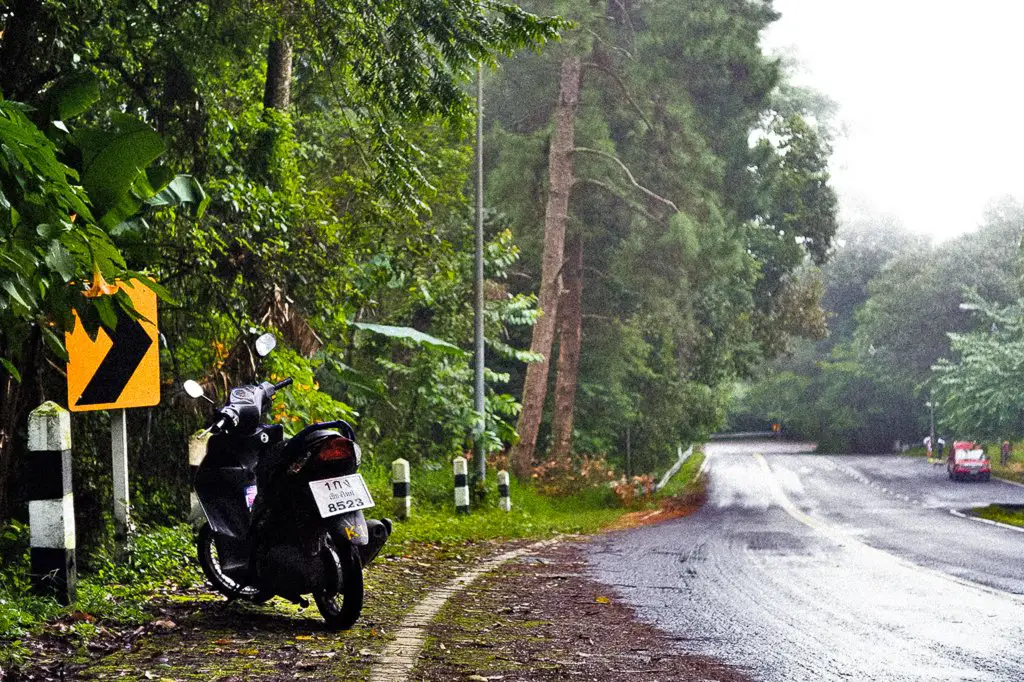
Riding a Scooter up Doi Suthep [F.Zuiko 38mm f1.8]

Although Chiang Mai is one of Thailand’s must-visit places, many of Chiang Mai’s must-see places are outside of the city.

The temple known as Wat Phra Doi Suthep is one such place. Around 15km out to the west of Chiang Mai, this temple sits near the top of a hill (Doi Suthep) and overlooks the city. As a destination for an easy yet immensely enjoyable scooter ride out of the city, with great views and a lovely temple to look around, it’s one of my personal must-dos when in Chiang Mai.

Rent a scooter and hit the road. Come and see how.

Chiang Mai Street Photography [Super-Takumar 55mm f1.8]

chiang mai street photography

Shooting monochrome street photography in a place as colourful as Chiang Mai might seem a waste, but it can help give a different feel to the images you get during your time there.

The question is, where in Chiang Mai should you go and shoot? I could suggest the entire city if you have the time to cover it, as every area offers something different, but that would be impractical to most.

Instead, here’s a couple of suggestions that can be covered in one day, with plenty of time left for that amazing Thai food.

Bangkok Protests [F.Zuiko 38mm f1.8]

The 2014 Bangkok protests were just the latest in a long line of similar events in Thailand’s capital. This wasn’t the first time I’d been in the city when there had been protests, but it was the first time I’d been to see them and shoot some pictures.

I had no idea how things would go. Whether I’d be welcomed or not, whether I’d feel vulnerable, or even if I’d make it out unhurt if something developed. In truth, the whole atmosphere was pretty carnival-like, and anyone I asked for a picture was happy to let me take one.

It’s a different kind of set to most of my others which tend to show a more relaxed side of travel. I’m glad I was able to go in and take these pictures, but I hope for Thailand’s sake they can move on in a manner that means no more protests of this type will be necessary.

Phuket Through a Vintage Lens [F.Zuiko 38mm f1.8]

drinks coolers on phuket beach thailand

On a trip to Phuket, Thailand, I never once set foot on a deserted beach. That’s not to say that photography from the beaches I did go to has to be unappealing.

Quite the contrary, in my opinion. Purely landscape photographs of holiday brochure beaches don’t really do it for me anymore, and trying to make a crowded beach look that way for the benefit of anyone viewing my images is not something I will ever do. It’s the same with any tourist destination. Shoot what’s there, not what people expect wasn’t.

My short time on Phuket took in a few different beaches and the inland Phuket Town. These pictures are from that trip, and there isn’t a deserted beach in sight.

Focal Length Explained Simply

Focal length is something I believe most hobbyist photographers can get away without knowing too much about. Especially those who never move beyond the kit lens. I don’t think it’s necessarily essential knowledge, and given the choice between learning it or going out shooting somewhere, I’d probably advise the latter.

The differences in your pictures caused by different focal lengths should be obvious to the naked eye, and you’ll know when you’re shooting what looks good and what doesn’t. Even if you don’t know why.

Having said that, an understanding of focal length is good to have when buying lenses, or simply wanting to know how zooming in alters your photographs in ways that simply getting closer to your subject doesn’t.

This then is a comprehensive yet simplified explanation of what focal length means for photographers. It explains how it affects your pictures without drowning you in science.

Khao San Road w/ Super-Takumar 55mm f1.8

hair braid mannequins on khao san road

Khao San Road, Bangkok. I started my day with the best intentions. I’d take my time, stalk around, capture the essence of the place, maybe (probably) have a few drinks after I’d finished.

Unfortunately, my day was interrupted by a familiar voice and face. This small set of images is what I got before that happened. Expect Same Same vests, daft trousers, braids, and a cat on a motorbike.

Super-Takumar 55mm f1.8 Lens Review

super-takumar 55mm f1.8 lens

The Super-Takumar 55mm f1.8 is a classic and slightly radioactive manual focus lens. Mine was the second manual focus lens I ever bought, and I quickly fell in love with it.

This in-depth review talks about the history of the lens, it’s radioactivity, how it is to use, why I bought it, and some notes on the image quality. Spoiler: it’s good.

With a selection of example shots taken with the lens to let you see for yourself, come and find out why I love the Super-Takumar 55mm f1.8 so much.

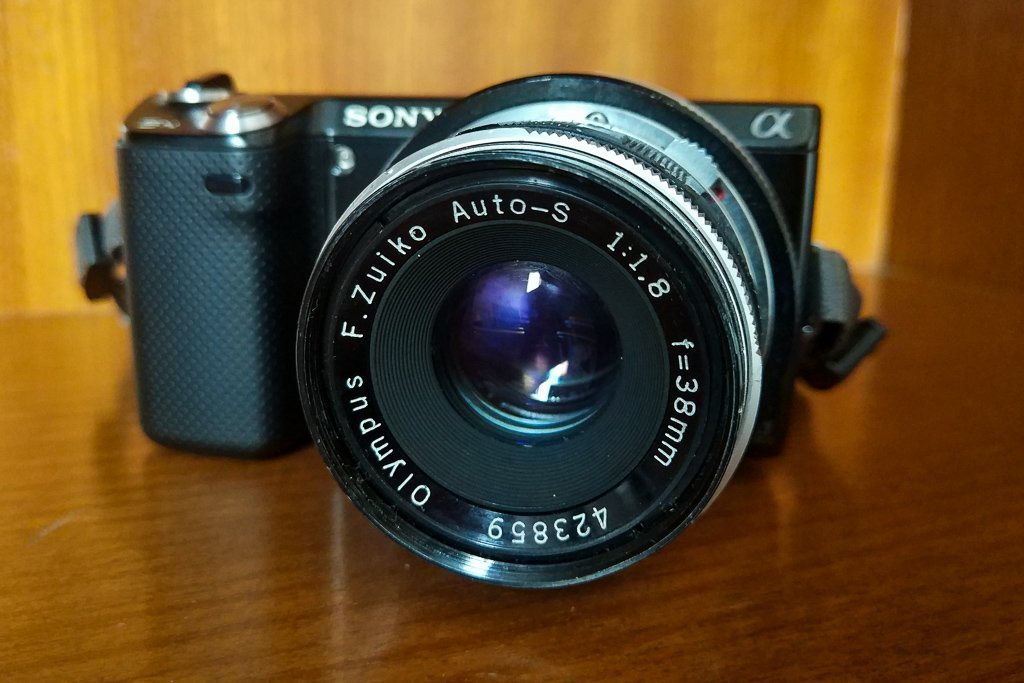
F.Zuiko 38mm f1.8 Lens Review

z.fuiko 38mm f1.8 lens

The F.Zuiko 38mm f1.8 was the first manual focus lens I ever bought, and it is something of a classic. Versatile, not too expensive and with good image quality, it’s an investment I’m glad I made.

This review talks about the history of the lens and its native camera, the Olympus Pen F; it describes how it is to use in the real world, and features a gallery of example shots.

I love using mine, and thought it was a very good lens to start shooting manual focus with due to it being wider than the common 50mm lenses. If you’ve been wondering whether to take the step into manual focus lens shooting or have had your eye on an F.Zuiko 38mm f1.8 yourself, come and see why I think so highly of mine.

Why Use Vintage Camera Lenses?

I love shooting with vintage camera lenses so much I made this whole website about the pictures I take with them as I travel around. But what is it about them that makes them so special?

For me, it’s a combination of a few things, as I explain in this post. I didn’t ever really plan to get into vintage lens shooting. It was a matter of circumstance, but I’m truly glad it happened the way it did.

Should you try shooting with some vintage camera lenses yourself? I really think so. Come read and find out why.